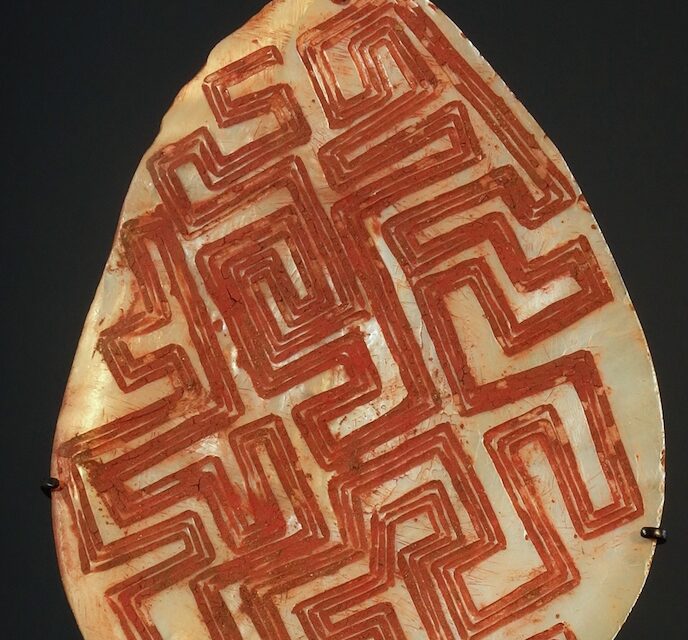
On the far north-west coast of Australia, one of the region’s most distinctive cultural objects begins with a pearl oyster shell rather than a pearl. Riji, the engraved pearl-shell pendants associated with Bardi and Jawi saltwater country, turn the shimmer of nacre into something far denser than ornament: a material record of sea country, ceremony, trade, and inherited skill.
What It Is
Riji are carved pearl-shell pendants made from the shell of the gold-lipped pearl oyster, Pinctada maxima. In Bardi and Jawi usage, the names riji and jakuli are attached to these engraved shells; related pearl-shell traditions also extend more broadly across Kimberley saltwater communities. The Met’s collection page describes them as engraved pearl-shell pendants attached to belts or hair-string, while the Western Australian Museum explains the distinction between guwan, the undecorated shell, and riji, the shell once it has been carved.
That difference matters. The object is not simply “mother-of-pearl art.” It begins as a specific marine shell gathered from a specific coastline and becomes culturally legible through shaping, incision, pigment, and use.
Where It Comes From
Riji belongs to the saltwater world of the Kimberley coast in Western Australia, especially the Dampier Peninsula and nearby island country north of Broome. The WA Museum’s online exhibition text places engraved pearlshell within the northwest Kimberley coast and notes that coastal Aboriginal groups collected the shell on king tides. The same source describes pearlshell as a long-travelled material in Aboriginal exchange networks, with archaeological evidence showing valued shell moving far inland over very long periods.
The geography is not incidental background. The shell itself comes from a marine environment of tidal flats, oyster beds, currents, and seasonal weather. The Met’s description ties the carved object to the gold-lipped pearl oyster, while Queensland Art Gallery | Gallery of Modern Art (QAGOMA) emphasizes the shell’s association with water, lightning, and summer storms in Bardi understandings of the material. The lustre that makes the object visually striking is the same lustre that anchors its symbolic force.
A Craft Shaped by Material and Country
Riji is a good example of a cultural object whose form is inseparable from its material base. The shell’s iridescent inner surface is not a neutral support. According to the Met, the engraved linear motifs move across the shell’s lustrous inner lip and signal water in multiple forms: rain, tides, and the tracks of ancestral beings. The WA Museum similarly frames the brilliance of mother-of-pearl as a manifestation of water and life.
That makes riji ecologically bound in a literal way. No pearl oyster shell, no riji. No north-western marine habitat, no shell of this particular size and sheen. The object depends on a coastal environment, tidal knowledge, and continued access to the shell itself. Even the timing of making can follow climate cues: QAGOMA’s Aubrey Tigan entry notes that shells are often engraved in the humid period before the wet season, when moist air is understood to soften them.
How It Is Made and Sustained
The making process begins with guwan, the plain shell. The WA Museum describes people collecting, cleaning, and shaping the shell, then incising ramu, or special lines and designs, into it. Ochre may be rubbed into the cuts to bring out the pattern; the same page shows Bardi elder Sandy Paddy Malilboor filling pearlshell designs with red ochre. QAGOMA notes that Aubrey Tigan used a dremel to incise the inner surface and then filled the lines with red ochre, which is a useful reminder that living traditions can preserve cultural form while using contemporary tools.
Public-facing sources are also careful about what they do not explain. The WA Museum says some riji designs carry gender-restricted esoteric meanings. That is a real boundary, and it changes how an outsider should write about the object. A responsible account can describe the public material facts, ceremonial importance, and visible making process without pretending every pattern has been made available for general interpretation.
The tradition is sustained not only through museum preservation but through working artists and intergenerational teaching. Short St Gallery’s biography for Sebastian Arrow says he learned pearlshell carving from senior law man and artist Aubrey Tigan, including preparation, procedure, and specific designs of riji. The gallery’s recent pearlshell viewing room presents works by Sebastian Arrow and Robert Wiggan as contemporary expressions of the same tradition.
What Kinds of Outputs Exist
Historically and ceremonially, riji were worn by men, often suspended from belts or hair-string. The Met describes riji with belt examples and notes their role in rites of passage and ceremony. QAGOMA identifies riji as a form of body adornment worn by young men after several stages of initiation and before full initiation. The WA Museum also points to related shell forms such as binji binji, smaller carved shell blades worn as headpieces or on hairbelts.
Today, public examples appear in several forms at once:
- historical museum holdings, where older ceremonial and exchange objects can be studied;
- contemporary carved pearlshell works made by named artists and shown through galleries;
- educational exhibition material that explains how shell, country, trade, and ceremony fit together.
That mix matters because riji is not a dead ethnographic type. It remains a living, governed practice that also circulates through museums, exhibitions, and carefully framed contemporary art contexts.
Real Examples You Can Inspect
If you want to look at actual examples rather than generic summaries, several strong public sources are available.
The Met’s riji with belt is especially useful because it is clearly identified, illustrated, and marked as on view in Gallery 353 in New York. For a contemporary named maker, the British Museum’s Aubrey Tigan riji shows carved and polished pearlshell incised with a Rainbow Serpent design and filled with red ochre. QAGOMA’s 2006 Aubrey Tigan work gives a strong museum record for a Bardi trading shell made of pearlshell, hair string, and natural pigment. And the WA Museum’s “Guwan” page is less an object listing than a compact primer on how shell becomes riji and why the material has mattered for so long.
For living makers, Short St Gallery’s pearlshell viewing room shows recent works by Sebastian Arrow and Robert Wiggan, which helps bridge the gap between older institutional holdings and present-day carving practice.
What Outsiders Often Misunderstand
The first misunderstanding is treating the pearl as the story and the shell as residue. In this tradition, the shell itself is the prized material. That point appears directly in museum and gallery material and helps explain why riji belongs as much to the history of shell, sea country, and exchange as it does to the better-known commercial pearling history of northern Australia.
The second misunderstanding is flattening riji into decorative “tribal art.” Public sources repeatedly insist on richer terms: ceremony, initiation, exchange, law, water, ancestral connection, and country. Even when a contemporary work is displayed in a gallery, it is not just pattern on an attractive surface.
The third is assuming that every visible design has been offered up for public decoding. It has not. The WA Museum explicitly notes that some meanings are restricted. The right stance for an outsider is descriptive, not possessive: look carefully, cite what communities and institutions have chosen to say publicly, and stop where the public record stops.
Why This Object Matters
Riji compresses several histories into one small object: marine ecology, long-distance exchange, ceremonial life, men’s adornment, family teaching, and contemporary artistic continuity. It is place-bound in the strongest sense. The shell comes from a specific sea country. The designs move with the shell’s curved inner face. The object’s force depends on water, weather, and inherited knowledge from Kimberley saltwater communities.
That combination is exactly why riji holds up as a serious cultural subject. It is beautiful, but beauty is the least interesting thing about it.
Further Reading and Source Note
This article relies on public-facing museum, collection, and artist pages that describe the tradition for general audiences. Where those sources indicate restricted meanings, the article avoids pushing beyond what has been made public.
- Western Australian Museum, “Guwan”
- The Metropolitan Museum of Art, “Riji, jakoli, or longkalongka (engraved pearl shell) with belt”
- QAGOMA, “Riji (pearlshell pendant): Traditional Bardi trading shell 2006”
- British Museum, “Riji” by Aubrey Tigan
- Short St Gallery, “Sebastian Arrow – Biography”
- Short St Gallery, “SPOTLIGHT ON PEARLSHELL: Artworks from the Bungalow”