I couldn’t remember how to start my Troy-Bilt pressure washer. I’ve been taught. It didn’t stick. So I went looking, and normally that’s a coin flip — ten minutes of scrubbing a fifteen-minute video, hunting for the thirty seconds where the guy actually touches the choke lever.
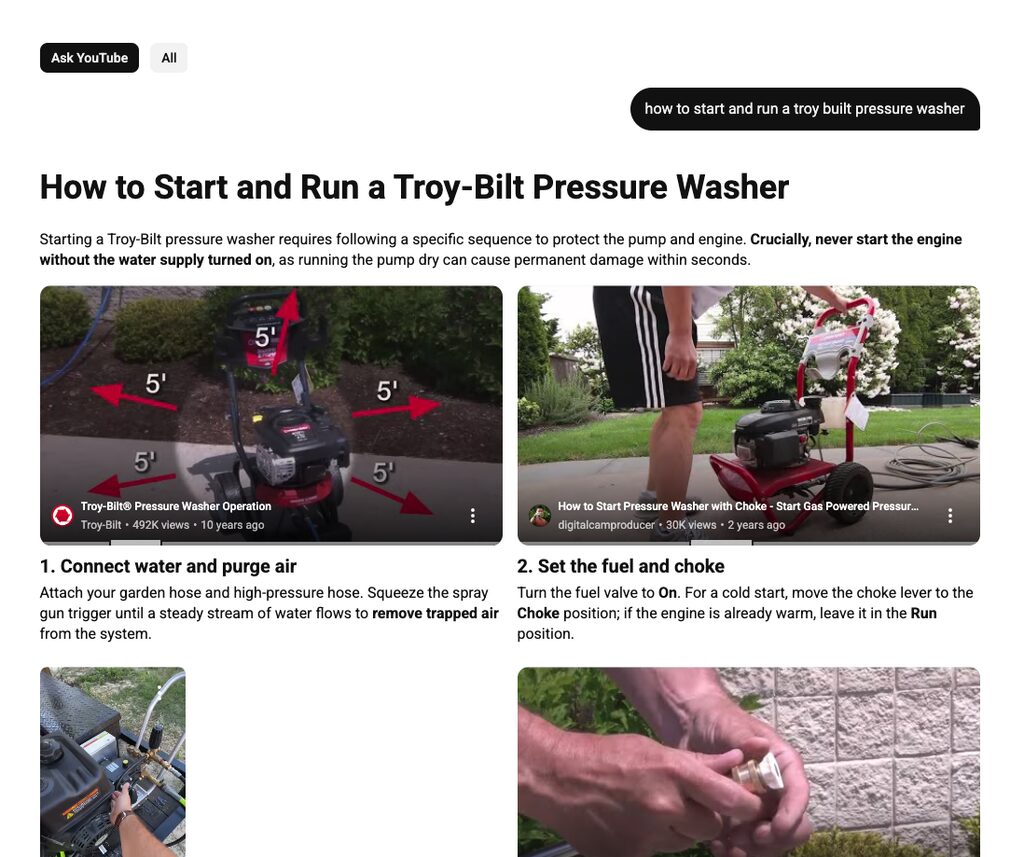
Instead I got a written-out, step-by-step answer with the actual videos embedded next to each step. Not links to go chase down later — the clips themselves, cued to the second where the thing happens. Connect the water and purge the air. Set the fuel valve and the choke. Every step sitting next to a real person doing that exact step, and I could watch it right there without leaving the page.
That’s the part that matters, and it’s why this belongs in Glass. It isn’t a summary telling me what to do. It’s video I can watch while I’m doing it — somebody’s hands on the same machine, at the exact moment I need to see them.
And right at the top, in bold, before any of the steps: don’t start the engine without the water on. Run the pump dry and you’ll wreck it in seconds. I didn’t ask for that. It knew that’s where people destroy the machine, so it led with it.
What this actually is
It’s called Ask YouTube — a conversational way to search that blends a text answer with real clips instead of handing you a grid of thumbnails. The videos play at the timestamp closest to what you asked, with the channel name and title attached so you can decide who to trust and go watch the whole thing. You can follow up, refine, keep the thread going. Right now it’s an opt-in experiment with limited rollout, so your mileage may vary on whether you even see the button.
This is what the web was supposed to do
This is bigger than a pressure washer.
The web was supposed to do this. Tim Berners-Lee said it in 1997, when the W3C launched its Web Accessibility Initiative: “The power of the Web is in its universality. Access by everyone regardless of disability is an essential aspect.” That was the point of the whole thing. Everybody gets in.
We got the first half. Everything is online now. Every repair, every recipe, every procedure — somebody wrote it down or filmed it. The knowledge is all there.
Getting to it is the part that never worked. Fifteen minutes of intro before the tutorial. A thousand words about somebody’s childhood before the recipe. Ten search results that are the same article rewritten. The answer existed. It was buried, because everybody wanted you on the page longer.
What was missing is distillation. Not more stuff. Fewer steps between the question and the answer. That’s what this does, and it doesn’t cut the person out — their name is on it, their channel is on it, and you’re watching them, not reading a machine’s description of them.
That’s the AI dream to me. Not a machine that knows everything. A machine that gets me to the person who does.
I was taught this already
I got taught how to start a pressure washer. Probably more than once. Somebody stood there and showed me the choke and the fuel valve and the trigger, and I knew it at the time.
It’s gone. That’s the injury. It didn’t take my thinking — I can still work things out. It took recall. The file is there when I reach for it or it isn’t, and I don’t get a say.
So I run on reference. Not look it up once and learn it. Look it up, do it, look it up again next spring, do it again. Same information, over and over, for as long as I need to do the task. That’s not laziness. That’s how it works now.
And asking twice feels bad. Most of us got taught that early — asking again means you weren’t paying attention. A grown man is supposed to know how to start an engine. So you don’t ask. You put it off. The thing stays broken, or you pay somebody, or you wait on a guy who’s going to sigh at you.
When the answer is just there, that cost goes to zero. Nobody sighs. Nobody says I already showed you. No favor owed, no appointment to make. The fifth time I ask is exactly as easy as the first.
That’s not convenience. That’s whether I do it myself or don’t do it at all. Across a whole life of small tasks, lifesaver is not too strong a word.
It’s not just me
Text answers next to video help if you can’t hear well. Video next to text helps if reading is the hard part. Steps you can re-enter at any point help if your attention breaks. Voice input helps if your hands are covered in grease or don’t work the way they used to. This is the difference between “I’ll have to call somebody” and “I can do this myself,” and if you’ve never been on the wrong side of that line, it’s hard to explain how much it matters.
The honest caveat
Google tells you straight out that quality and accuracy vary and you should check anything important in more than one place. Believe them. On a pressure washer, a wrong step costs you a pump. On wiring, or gas, or anything with a real consequence attached, it costs more than that. The confident tone of a generated answer is not the same thing as being right.
But the fix is built into the thing itself. It’s not a black box telling you what to do — it’s handing you real people doing the real work, with their names on it. When it matters, watch the whole video. That’s the whole trick, and it’s why this beats a chatbot confidently making up a procedure.
If Glass worked, I’d be in the yard
Here’s how I actually got here. I wasn’t testing an AI feature. I was standing in my yard trying to start a machine I’d already been taught to start, looking for a way around my own memory. What I found was that the thing we’ve been promising ourselves for thirty years is built and working.
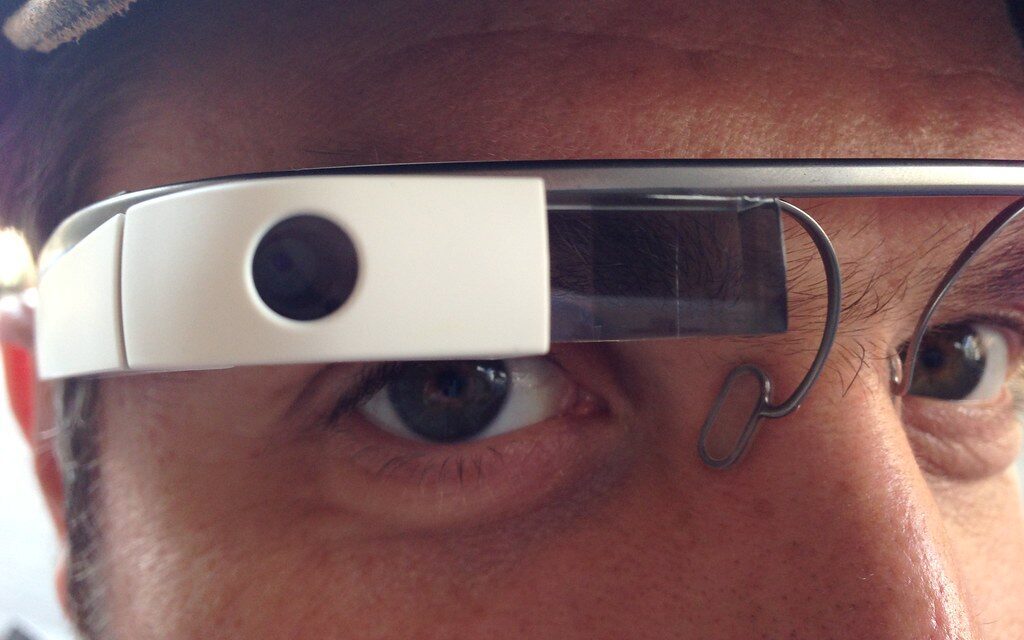
Google Glass promised information in your eye line, at the moment you need it, hands free. Everybody remembers why it failed — the price, the camera, the look. But the display was never the real problem. The problem was there was nothing worth putting in it. Directions and your texts. Not worth a computer on your face.
This is what was worth putting in it. Not text. Video. The guy who knows, playing in the corner of my vision, at the second I need him.
Because I still had to stop, look down, read, and walk back out. If Glass had worked, and I had it on right now, I wouldn’t be reading about starting the pressure washer. I’d be in the yard starting it. Hands on the machine, eyes on the machine, watching somebody do the next step while I do the next step.
The knowledge is solved. Finding it is solved. What’s left is the last three feet between the screen and the work — and that’s a hardware problem, and hardware problems get solved.
My pressure washer started on the second pull.





I love the idea of using Google Glass for practical tutorials! It’s fascinating how technology can help us remember steps we often forget, like those for starting a pressure washer.
It’s so interesting how the integration of Google Glass into everyday tasks can totally change our approach to DIY projects. The pressure washer tutorial angle is especially clever, as those small details really make a difference when you’re trying to remember everything!
The concept of using Google Glass to assist with pressure washer tutorials is brilliant! It’s amazing to think about how augmented reality can provide visual guidance for tasks we might struggle to recall, like the exact sequence of starting the machine. This approach could really enhance learning and make DIY projects much more accessible to everyone!
I find it really intriguing how Google Glass can bridge the gap between forgetting and executing practical tasks like starting a pressure washer. That visual aid could make all the difference in ensuring every step is followed correctly, especially for those of us who struggle with memory!
I appreciate how the article highlights the challenge of forgetting complex steps, like those in starting a pressure washer. The idea of using Google Glass as a memory aid really resonates, especially for visual learners who benefit from seeing each step in action. It makes the process feel much more manageable and less intimidating!
It’s really impressive how the author captures the struggle of remembering the steps for using a pressure washer. The idea of merging this common DIY task with the capabilities of Google Glass not only sparks innovation but also opens up a discussion on how technology can serve us in practical ways. Visual reminders in a pressure washer tutorial could truly transform how we approach these tasks!